October 16, 2026
October 16, 2026
How to Know If a Company Is Fake in Nigeria
Some fake companies have no registration at all. Others have a real CAC number, a real logo, even a real office photo. If you are about to apply, invest, sign or pay, learn how to know if a company is fake before it costs you.
Some fake companies have no registration at all. Others have a real CAC number, a real logo, even a real office photo. If you are about to apply, invest, sign or pay, learn how to know if a company is fake before it costs you.
Fake companies now borrow real names, logos and registrations. Here are the five types to recognise and the checks that expose them in Nigeria.
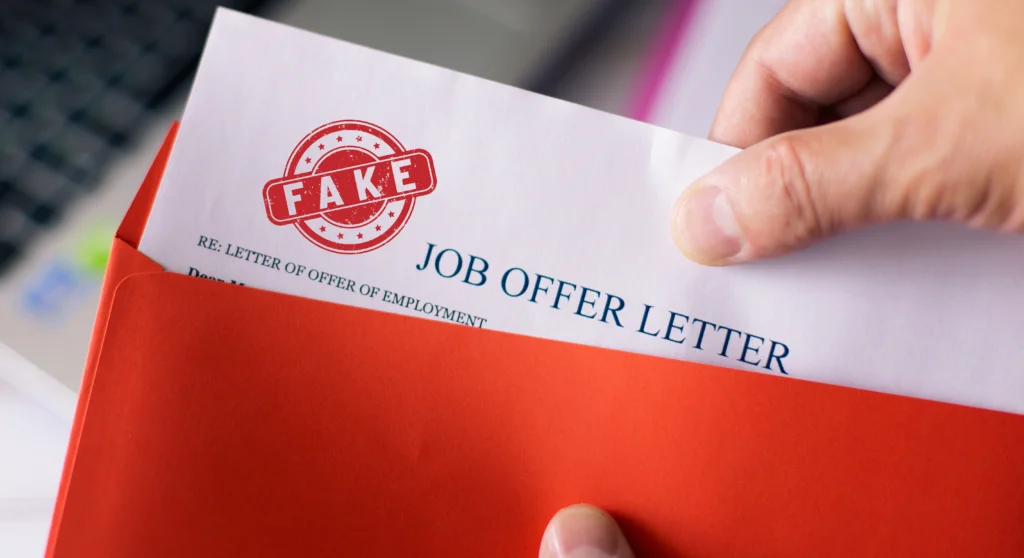
The letter carried a familiar logo. It was dated 18 August 2026 and titled a provisional offer of employment from the Federal Airports Authority of Nigeria. There was just one problem: FAAN said it was not running any recruitment at all, and the letter was fake.
This is what fake companies look like now. Not badly spelt flyers, but polished documents, real brand names and convincing websites. So how do you know if a company is fake in Nigeria when the surface looks perfect?
The answer is to stop asking "does this look real?" and start asking "which kind of fake could this be?" Each type of fake company leaves different clues. This guide breaks down the five types, the warning signs for each, and a quick set of checks you can run before you apply, invest, sign or pay.
Why Fake Companies Are Harder to Spot in 2026
Fake companies are thriving in the gaps between what looks official and what is actually verified.
Impersonation of trusted names is constant. Within weeks of FAAN's warning, the Nigeria Revenue Service disowned a fake recruitment advert circulating online under the old FIRS name, which asked applicants to send details to an email address unconnected to the agency. Scammers even exploit name changes, betting that people will not know which name is current.
Registered does not mean active. In July 2026, the CAC began moves to strike off 100,000 companies that had failed to file annual returns or ownership information, after deregistering over 400,000 inactive and non-compliant companies in 2025. A company name you find on old documents may no longer be in good standing.
Professional adverts prove nothing. In October 2026, the SEC disowned WayvePay, saying it was not registered to solicit investments from the public, after it advertised access to the Dangote Petroleum Refinery IPO in a newspaper notice.
The Five Types of Fake Companies in Nigeria
Knowing the type tells you where to look.
The phantom company. It is not registered anywhere. It exists only as a page, a website or a WhatsApp number. A CAC search returns nothing.
The clone. It borrows a real organisation's name, logo, RC number or letterhead, like the fake FAAN offer letter. The real company exists; the people contacting you do not represent it.
The shell. It is or was genuinely registered, but nothing real stands behind it: no operations, no staff, no office. Some are dormant or struck off.
The unlicensed operator. It is registered with CAC but not licensed for the regulated work it offers, such as investments, lending or recruitment for public agencies.
The fake employer. A "company" whose main product is job offers, usually followed by fees for training, medicals, uniforms or documentation.
Consider Ibrahim in Kano (an illustrative example). An "oil and gas firm" offers him a job after a short phone interview and sends a professional offer letter. The firm's CAC record exists, but its registered address is a residential street in another state, its email uses a free email service, and its website was built three weeks ago. Each detail alone is explainable. Together, they describe a shell company running a recruitment scam.
Warning Signs That a Company Is Fake
Look for these clues across four areas:
Online presence
A website that is very new, has no physical address, or uses stock photos for "our team".
Email addresses on free services instead of the company's own domain.
A domain or social handle that is slightly different from the real company's.
Documents
No RC or BN number, or one that does not match the CAC record.
Letterheads with spelling errors, wrong agency names or outdated logos.
Offer letters or contracts sent before any real interview or due diligence.
Money
Requests for "processing", "training", "medical" or "registration" fees.
Payment into a personal account or an account in a different name.
Guaranteed or unusually high returns on investment.
People
Staff you cannot find anywhere else online.
Directors on the CAC record who have no connection to the people contacting you.
Pressure to act quickly, keep things confidential or skip official channels.
How Do You Know If a Company Is Fake in Nigeria?
To know if a company is fake in Nigeria, confirm it is registered with CAC and still active, check that it is licensed for its work, confirm that the people and channels contacting you genuinely belong to it, and verify its physical presence and history. If any check fails, or the company resists verification, treat it as fake until proven otherwise.
Check 1: Is it registered, and still active?
Search the exact name on the CAC register and compare the RC or BN number, registration date and status with the company's documents. Our guide to the free CAC company search by name walks you through it. If you only have an RC number from a letter or invoice, follow our guide on how to verify a company by RC number. A missing record suggests a phantom company; a struck-off or inactive status suggests a shell.
Check 2: Is it licensed for what it does?
Ask which regulator oversees the company's work and check directly with that regulator. Investment platforms should be registered with the SEC. Banks and lenders should be licensed by the CBN. Property developers can be checked against official housing complaint channels, as our article on the federal digital portal to combat housing fraud explains.
Check 3: Are the people contacting you really from the company?
This is how you catch clones. Find the organisation's official website and contact details yourself, not through links sent to you. Call or email them through those channels and ask whether the offer, invoice or person is genuine. For public agencies, check their official website and verified social media accounts for recruitment notices. Our guide on how to verify ongoing recruitment covers fake job adverts in detail.
Check 4: Does it exist in the real world?
Look up the registered and operating addresses on Google Maps and, where possible, visit or ask someone nearby. Check whether the business actually operates there. Search the company's name with "scam", "fraud" or "complaint", and look for history: news coverage, past projects, real customers and independent reviews.
Check 5: Does the money trail make sense?
A genuine company does not charge job applicants for offers, and it receives payments into accounts in its own name. If the money request does not fit how real businesses operate, the company likely is not real either.
Where Profiled Fits
Running all five checks takes time, and some gaps, such as confirming who really sits behind a company, are hard to close alone. Profiled Nigeria's business and vendor verification services combine data intelligence, automated validation and human review to flag inconsistencies across a company's records and claims. When the risk is the individual, such as a recruiter, agent or director, iAMProfiled verifies identity, address, facial data, digital footprint and behavioural reliability, summed up in a PRODoT Score. No check makes risk disappear, but verified facts beat a polished letterhead every time.
Fake vs Genuine Company: Quick Comparison
Area | Genuine company | Likely fake |
CAC record | Active, and details match its documents | Missing, struck off or mismatched |
Licence | Confirmed directly with the regulator | Vague answers or "pending approval" |
Contact channels | Own domain email, official numbers | Free email, WhatsApp-only, lookalike domains |
Address | Operates at a verifiable location | Residential, virtual or constantly changing |
People | Staff and directors can be found and confirmed | Names appear nowhere else |
Money | Payments to company accounts; no fees for job offers | Fees upfront, personal accounts, guaranteed returns |
What to Do If You Have Dealt With a Fake Company
Stop all contact and payments. Do not pay further fees, even if promised a refund.
Call your bank immediately if you sent money, and ask them to flag the receiving account.
Keep the evidence. Save letters, emails, chats, adverts, website links and payment receipts.
Tell the real organisation if a clone used its name. Contact it through its official website so it can warn others.
Report it. File a report on the NPF National Cybercrime Centre's e-reporting portal or at a police station. For fake investment platforms, also alert the SEC.
Protect your identity. If you shared your BVN, NIN, certificates or bank details, alert your bank and watch for suspicious activity.
Falling for a well-built fake company is not a personal failing. Reporting it quickly protects you and the next person they target.
Frequently Asked Questions
How can I check if a company is real in Nigeria? Search the company's exact name on the CAC register and confirm its RC number, status and details match its documents. Then check it is licensed for its work, contact it through official channels you found yourself, and confirm its address and history. A real company will pass all of these checks without resisting.
Can a registered company still be fake? Yes. A company can be genuinely registered but have no real operations, be inactive or struck off, or lack the licence it needs. Scammers also copy real companies' names and RC numbers. Registration is the first check, not the last. Always confirm the company is active, licensed and genuinely the one contacting you.
How do I know if a job offer letter is fake? Check whether the organisation is actually recruiting through its official website and verified social media pages. Be wary of offers without a real interview, letters from free email addresses, and any request for fees. Contact the organisation directly using details you find yourself to confirm the letter is genuine.
What does it mean if a company is struck off by CAC? It means the company has been removed from the register, often for failing to file annual returns or required information. A struck-off company is no longer in good legal standing. If a company you are dealing with is struck off, ask questions before signing, investing or paying anything.
Where do I report a fake company in Nigeria? Report fraud to the police through the NPF National Cybercrime Centre portal or a police station. If money was sent, call your bank's fraud line immediately. For fake investment platforms, alert the SEC. If a fake company is impersonating a real organisation, inform that organisation through its official channels.
Conclusion
Fake companies rarely look fake anymore. They borrow real names, real logos and sometimes real registrations. The way to beat them is to know which type you might be facing and check what each type cannot fake: active registration, a genuine licence, official contact channels, real-world presence and a sensible money trail.
Profiled Nigeria's business verification and identity checks help you confirm a company and the people behind it before you commit your time, documents or money. See how verification works in practice in our case studies.
Remember: a real logo is easy to copy. A verified company is not.
Verify before you commit. Create your free Profiled account today.


Fake companies now borrow real names, logos and registrations. Here are the five types to recognise and the checks that expose them in Nigeria.
The letter carried a familiar logo. It was dated 18 August 2026 and titled a provisional offer of employment from the Federal Airports Authority of Nigeria. There was just one problem: FAAN said it was not running any recruitment at all, and the letter was fake.
This is what fake companies look like now. Not badly spelt flyers, but polished documents, real brand names and convincing websites. So how do you know if a company is fake in Nigeria when the surface looks perfect?
The answer is to stop asking "does this look real?" and start asking "which kind of fake could this be?" Each type of fake company leaves different clues. This guide breaks down the five types, the warning signs for each, and a quick set of checks you can run before you apply, invest, sign or pay.
Why Fake Companies Are Harder to Spot in 2026
Fake companies are thriving in the gaps between what looks official and what is actually verified.
Impersonation of trusted names is constant. Within weeks of FAAN's warning, the Nigeria Revenue Service disowned a fake recruitment advert circulating online under the old FIRS name, which asked applicants to send details to an email address unconnected to the agency. Scammers even exploit name changes, betting that people will not know which name is current.
Registered does not mean active. In July 2026, the CAC began moves to strike off 100,000 companies that had failed to file annual returns or ownership information, after deregistering over 400,000 inactive and non-compliant companies in 2025. A company name you find on old documents may no longer be in good standing.
Professional adverts prove nothing. In October 2026, the SEC disowned WayvePay, saying it was not registered to solicit investments from the public, after it advertised access to the Dangote Petroleum Refinery IPO in a newspaper notice.
The Five Types of Fake Companies in Nigeria
Knowing the type tells you where to look.
The phantom company. It is not registered anywhere. It exists only as a page, a website or a WhatsApp number. A CAC search returns nothing.
The clone. It borrows a real organisation's name, logo, RC number or letterhead, like the fake FAAN offer letter. The real company exists; the people contacting you do not represent it.
The shell. It is or was genuinely registered, but nothing real stands behind it: no operations, no staff, no office. Some are dormant or struck off.
The unlicensed operator. It is registered with CAC but not licensed for the regulated work it offers, such as investments, lending or recruitment for public agencies.
The fake employer. A "company" whose main product is job offers, usually followed by fees for training, medicals, uniforms or documentation.
Consider Ibrahim in Kano (an illustrative example). An "oil and gas firm" offers him a job after a short phone interview and sends a professional offer letter. The firm's CAC record exists, but its registered address is a residential street in another state, its email uses a free email service, and its website was built three weeks ago. Each detail alone is explainable. Together, they describe a shell company running a recruitment scam.
Warning Signs That a Company Is Fake
Look for these clues across four areas:
Online presence
A website that is very new, has no physical address, or uses stock photos for "our team".
Email addresses on free services instead of the company's own domain.
A domain or social handle that is slightly different from the real company's.
Documents
No RC or BN number, or one that does not match the CAC record.
Letterheads with spelling errors, wrong agency names or outdated logos.
Offer letters or contracts sent before any real interview or due diligence.
Money
Requests for "processing", "training", "medical" or "registration" fees.
Payment into a personal account or an account in a different name.
Guaranteed or unusually high returns on investment.
People
Staff you cannot find anywhere else online.
Directors on the CAC record who have no connection to the people contacting you.
Pressure to act quickly, keep things confidential or skip official channels.
How Do You Know If a Company Is Fake in Nigeria?
To know if a company is fake in Nigeria, confirm it is registered with CAC and still active, check that it is licensed for its work, confirm that the people and channels contacting you genuinely belong to it, and verify its physical presence and history. If any check fails, or the company resists verification, treat it as fake until proven otherwise.
Check 1: Is it registered, and still active?
Search the exact name on the CAC register and compare the RC or BN number, registration date and status with the company's documents. Our guide to the free CAC company search by name walks you through it. If you only have an RC number from a letter or invoice, follow our guide on how to verify a company by RC number. A missing record suggests a phantom company; a struck-off or inactive status suggests a shell.
Check 2: Is it licensed for what it does?
Ask which regulator oversees the company's work and check directly with that regulator. Investment platforms should be registered with the SEC. Banks and lenders should be licensed by the CBN. Property developers can be checked against official housing complaint channels, as our article on the federal digital portal to combat housing fraud explains.
Check 3: Are the people contacting you really from the company?
This is how you catch clones. Find the organisation's official website and contact details yourself, not through links sent to you. Call or email them through those channels and ask whether the offer, invoice or person is genuine. For public agencies, check their official website and verified social media accounts for recruitment notices. Our guide on how to verify ongoing recruitment covers fake job adverts in detail.
Check 4: Does it exist in the real world?
Look up the registered and operating addresses on Google Maps and, where possible, visit or ask someone nearby. Check whether the business actually operates there. Search the company's name with "scam", "fraud" or "complaint", and look for history: news coverage, past projects, real customers and independent reviews.
Check 5: Does the money trail make sense?
A genuine company does not charge job applicants for offers, and it receives payments into accounts in its own name. If the money request does not fit how real businesses operate, the company likely is not real either.
Where Profiled Fits
Running all five checks takes time, and some gaps, such as confirming who really sits behind a company, are hard to close alone. Profiled Nigeria's business and vendor verification services combine data intelligence, automated validation and human review to flag inconsistencies across a company's records and claims. When the risk is the individual, such as a recruiter, agent or director, iAMProfiled verifies identity, address, facial data, digital footprint and behavioural reliability, summed up in a PRODoT Score. No check makes risk disappear, but verified facts beat a polished letterhead every time.
Fake vs Genuine Company: Quick Comparison
Area | Genuine company | Likely fake |
CAC record | Active, and details match its documents | Missing, struck off or mismatched |
Licence | Confirmed directly with the regulator | Vague answers or "pending approval" |
Contact channels | Own domain email, official numbers | Free email, WhatsApp-only, lookalike domains |
Address | Operates at a verifiable location | Residential, virtual or constantly changing |
People | Staff and directors can be found and confirmed | Names appear nowhere else |
Money | Payments to company accounts; no fees for job offers | Fees upfront, personal accounts, guaranteed returns |
What to Do If You Have Dealt With a Fake Company
Stop all contact and payments. Do not pay further fees, even if promised a refund.
Call your bank immediately if you sent money, and ask them to flag the receiving account.
Keep the evidence. Save letters, emails, chats, adverts, website links and payment receipts.
Tell the real organisation if a clone used its name. Contact it through its official website so it can warn others.
Report it. File a report on the NPF National Cybercrime Centre's e-reporting portal or at a police station. For fake investment platforms, also alert the SEC.
Protect your identity. If you shared your BVN, NIN, certificates or bank details, alert your bank and watch for suspicious activity.
Falling for a well-built fake company is not a personal failing. Reporting it quickly protects you and the next person they target.
Frequently Asked Questions
How can I check if a company is real in Nigeria? Search the company's exact name on the CAC register and confirm its RC number, status and details match its documents. Then check it is licensed for its work, contact it through official channels you found yourself, and confirm its address and history. A real company will pass all of these checks without resisting.
Can a registered company still be fake? Yes. A company can be genuinely registered but have no real operations, be inactive or struck off, or lack the licence it needs. Scammers also copy real companies' names and RC numbers. Registration is the first check, not the last. Always confirm the company is active, licensed and genuinely the one contacting you.
How do I know if a job offer letter is fake? Check whether the organisation is actually recruiting through its official website and verified social media pages. Be wary of offers without a real interview, letters from free email addresses, and any request for fees. Contact the organisation directly using details you find yourself to confirm the letter is genuine.
What does it mean if a company is struck off by CAC? It means the company has been removed from the register, often for failing to file annual returns or required information. A struck-off company is no longer in good legal standing. If a company you are dealing with is struck off, ask questions before signing, investing or paying anything.
Where do I report a fake company in Nigeria? Report fraud to the police through the NPF National Cybercrime Centre portal or a police station. If money was sent, call your bank's fraud line immediately. For fake investment platforms, alert the SEC. If a fake company is impersonating a real organisation, inform that organisation through its official channels.
Conclusion
Fake companies rarely look fake anymore. They borrow real names, real logos and sometimes real registrations. The way to beat them is to know which type you might be facing and check what each type cannot fake: active registration, a genuine licence, official contact channels, real-world presence and a sensible money trail.
Profiled Nigeria's business verification and identity checks help you confirm a company and the people behind it before you commit your time, documents or money. See how verification works in practice in our case studies.
Remember: a real logo is easy to copy. A verified company is not.
Verify before you commit. Create your free Profiled account today.