September 30, 2026
September 30, 2026
Emmanuel Ajao’s Mission to Make Nigeria’s Digital Economy Safer
Behind every online payment, job offer, and unfamiliar meeting is a question Nigerians cannot afford to ignore: who can I trust? Emmanuel Ajao, co-founder of Profiled Nigeria, is applying his technology and security background to help people answer with evidence.
Behind every online payment, job offer, and unfamiliar meeting is a question Nigerians cannot afford to ignore: who can I trust? Emmanuel Ajao, co-founder of Profiled Nigeria, is applying his technology and security background to help people answer with evidence.
Emmanuel Ajao’s work connects cybersecurity, identity verification, and public education to a pressing Nigerian challenge: making digital opportunities safer to pursue and easier to trust.
The Question Behind Nigeria’s Digital Progress
A customer discovers a business on Instagram. A graduate receives a recruitment message. An entrepreneur finds a supplier through WhatsApp.
The connection happens quickly. Establishing whether the person on the other end deserves confidence can take considerably longer.
This gap between connection and confidence sits at the centre of Emmanuel Ajao’s work as co-founder of Profiled Nigeria.
His public message is consistent: people should have practical ways to establish who they are dealing with before an interaction becomes a financial commitment or a personal risk.
In a February 2026 partner feature published by TechCabal, Ajao described the uncertainty surrounding ordinary online interactions as a systemic problem. The article connected his earlier work in cyber defence and forensics analysis to his interest in preventive verification. Read the TechCabal feature.
That connection gives his work a clear direction: bringing the discipline of checking evidence into decisions that Nigerians make every day.
A Professional Background Focused on Systems and Accountability
A February 2026 Techeconomy interview describes Ajao’s background as spanning nearly two decades across cyber defence, systems analysis, and technology strategy. Profiled Nigeria’s own biography lists 18 years in technology strategy. These are published biographical descriptions, rather than an independently audited employment history. Techeconomy interview; Profiled Nigeria biography.
In the interview, Ajao explains how apparently secure systems could fail when unchecked assumptions went unnoticed. His resulting emphasis is on building accountability into how a system operates.
This is an important foundation for a verification business. A reassuring interface or convincing document cannot, by itself, answer every question about an unfamiliar person.
For a consumer, that principle translates into practical scrutiny: Does this identity belong to the person contacting me? Do they represent the business they mention? What evidence supports the offer?
Ajao’s professional story is strongest where it connects this analytical approach to a recognisable public need.
Why This Work Matters: Billions Still Lost to Fraud
Nigeria has made progress against digital payment fraud, but the remaining losses show why prevention matters.
NIBSS reported that digital payment fraud losses fell from ₦52.26 billion in 2024 to ₦25.85 billion in 2025. The improvement is substantial; the amount still lost remains serious. These figures concern reported digital payment fraud, rather than every form of online deception. Source: NIBSS.
There is no basis in these figures to attribute the national improvement to Profiled Nigeria. They establish the scale of the problem that companies working on verification and fraud prevention are addressing.
For an individual, even one loss can interrupt rent payments, school fees, or business operations. For an honest seller, widespread suspicion can make winning a new customer harder.
This gives digital trust an economic purpose. Better evidence can help buyers assess risk and give legitimate businesses a clearer way to demonstrate credibility.
Moving Verification Earlier in the Customer Journey
One of the clearest contributions of Ajao’s work is the emphasis on when verification should happen.
Profiled Nigeria’s publicly announced strategy places identity and profile checks before transactions, partnerships, and meetings. Its stated product direction also includes business and vendor verification. Source: Techeconomy’s coverage of Profiled Nigeria’s strategy.
The practical change is straightforward. Someone considering a payment should have an opportunity to investigate uncertainty while they can still decide whether to proceed.
Consider an illustrative example: an Ibadan retailer finds a new supplier offering unusually cheap stock. The supplier provides photographs, a business name, and bank details.
A useful assessment would examine several separate questions:
Is the supplier’s identity consistent?
Does the person actually represent the business?
Is there credible evidence that the stock exists?
Do the payment details fit the transaction?
Are the delivery and refund terms documented?
No single answer settles all the others. The value lies in making the decision more informed.
Designing for How Nigerians Actually Trade
In his Techeconomy interview, Ajao emphasises Nigeria’s informal economy and describes an approach combining multiple information sources with human review where inconsistencies arise. This is his account of the company’s approach, rather than an independent performance assessment. Read his explanation.
The design challenge is significant. A small trader may operate mainly through referrals and WhatsApp. A convincing fraudster may have polished branding and formal-looking documents.
A useful verification process must help users understand the meaning and limitations of the evidence available.
Profiled Nigeria’s educational material makes a related distinction: confirming an identity does not establish someone’s character, qualifications, or entitlement to make a particular claim. Its background-check guide encourages separate checks for separate assertions. Read the background-check guide.
That distinction strengthens digital literacy. It helps people move beyond a simple “verified or unverified” label towards understanding what they actually know.
SecureMeet Addresses the Move From Online Contact to Physical Meetings
Digital interactions often lead to physical encounters: inspecting a property, collecting a device, discussing a service, or meeting a prospective business partner.
Profiled Nigeria presents SecureMeet as part of its response to that transition, with an emphasis on verifying the people involved in personal and professional encounters. Source: Profiled Nigeria’s product strategy coverage.
Its relevance is the connection between identity uncertainty and real-world decisions. Knowing more about someone before arranging a meeting can support better judgement about whether and how to proceed.
Verification must still be accompanied by sensible precautions, including appropriate meeting locations and clear arrangements. It cannot guarantee another person’s intentions or eliminate every physical risk.
Public Education Makes the Mission More Accessible
Ajao’s public contribution also includes explaining digital risks in terms that ordinary users can apply.
Profiled Nigeria identifies him as Chief Editor on its company-verification article. The guidance asks readers to examine business registration, relevant licences, the people representing a company, and payment details. Read “How to Verify a Company in Nigeria”.
This educational work matters because access to a tool does not automatically teach someone which question to ask.
For a job seeker, checking that an employer exists is only the beginning. They also need to establish that the recruiter represents it. For a buyer, identifying a vendor still leaves questions about the goods and transaction terms.
By connecting familiar situations to specific checks, the Profiled Nigeria blog gives its trust mission a practical public-facing form.
What the Evidence Says About His Emerging Influence
Ajao’s argument has also reached audiences beyond the company’s own channels. The Fintech Association of Kenya shared a public summary of Profiled Nigeria’s preventive verification approach and his perspective on digital trust. That demonstrates circulation of the idea; it does not establish a partnership or independently validate product performance. View the association’s commentary.
Taken together, the public record supports an emerging contribution through product development, practical education, and advocacy for earlier verification.
A stronger assessment of large-scale impact will require published evidence: completed checks, documented outcomes, verification accuracy, complaint resolution, and independently assessed reductions in harm.
Those measures would make it possible to evaluate how far the mission has translated into protection.
Conclusion
Emmanuel Ajao’s work brings a clear priority to Nigeria’s digital landscape: people need usable evidence before they commit their money, information, or safety.
His published background in security and systems thinking helps explain that priority. Profiled Nigeria gives it a practical direction through verification tools, public education, and SecureMeet’s focus on safer encounters.
The opportunity is substantial: helping more Nigerians approach digital commerce and relationships with informed confidence. Achieving it requires reliable tools, transparent results, and users who make verification a habit.
Before paying an unfamiliar vendor, trusting an offer, or arranging a meeting, pause to check the evidence. That everyday decision is where a more trustworthy digital Nigeria begins.

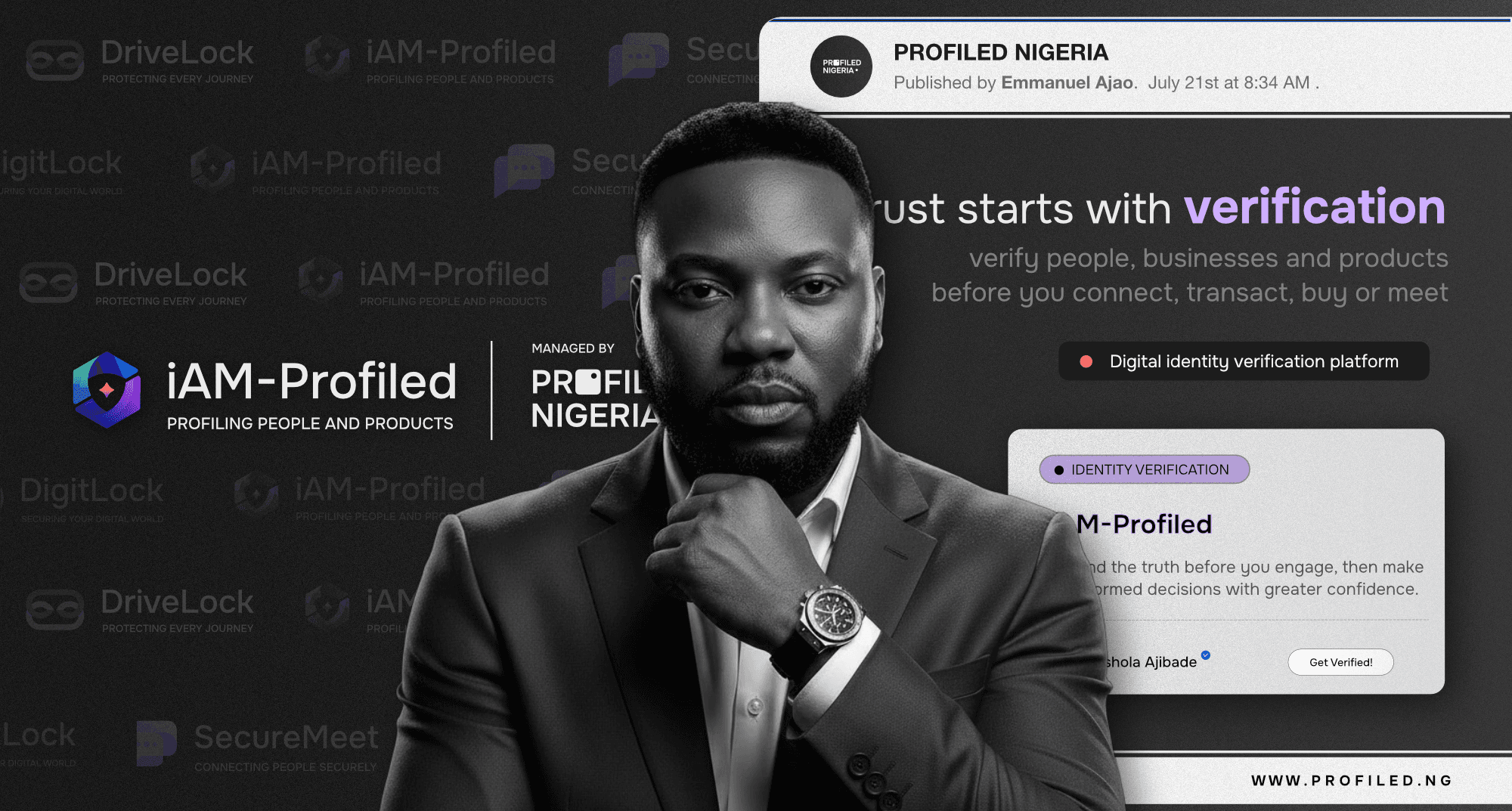


Emmanuel Ajao’s work connects cybersecurity, identity verification, and public education to a pressing Nigerian challenge: making digital opportunities safer to pursue and easier to trust.
The Question Behind Nigeria’s Digital Progress
A customer discovers a business on Instagram. A graduate receives a recruitment message. An entrepreneur finds a supplier through WhatsApp.
The connection happens quickly. Establishing whether the person on the other end deserves confidence can take considerably longer.
This gap between connection and confidence sits at the centre of Emmanuel Ajao’s work as co-founder of Profiled Nigeria.
His public message is consistent: people should have practical ways to establish who they are dealing with before an interaction becomes a financial commitment or a personal risk.
In a February 2026 partner feature published by TechCabal, Ajao described the uncertainty surrounding ordinary online interactions as a systemic problem. The article connected his earlier work in cyber defence and forensics analysis to his interest in preventive verification. Read the TechCabal feature.
That connection gives his work a clear direction: bringing the discipline of checking evidence into decisions that Nigerians make every day.
A Professional Background Focused on Systems and Accountability
A February 2026 Techeconomy interview describes Ajao’s background as spanning nearly two decades across cyber defence, systems analysis, and technology strategy. Profiled Nigeria’s own biography lists 18 years in technology strategy. These are published biographical descriptions, rather than an independently audited employment history. Techeconomy interview; Profiled Nigeria biography.
In the interview, Ajao explains how apparently secure systems could fail when unchecked assumptions went unnoticed. His resulting emphasis is on building accountability into how a system operates.
This is an important foundation for a verification business. A reassuring interface or convincing document cannot, by itself, answer every question about an unfamiliar person.
For a consumer, that principle translates into practical scrutiny: Does this identity belong to the person contacting me? Do they represent the business they mention? What evidence supports the offer?
Ajao’s professional story is strongest where it connects this analytical approach to a recognisable public need.
Why This Work Matters: Billions Still Lost to Fraud
Nigeria has made progress against digital payment fraud, but the remaining losses show why prevention matters.
NIBSS reported that digital payment fraud losses fell from ₦52.26 billion in 2024 to ₦25.85 billion in 2025. The improvement is substantial; the amount still lost remains serious. These figures concern reported digital payment fraud, rather than every form of online deception. Source: NIBSS.
There is no basis in these figures to attribute the national improvement to Profiled Nigeria. They establish the scale of the problem that companies working on verification and fraud prevention are addressing.
For an individual, even one loss can interrupt rent payments, school fees, or business operations. For an honest seller, widespread suspicion can make winning a new customer harder.
This gives digital trust an economic purpose. Better evidence can help buyers assess risk and give legitimate businesses a clearer way to demonstrate credibility.
Moving Verification Earlier in the Customer Journey
One of the clearest contributions of Ajao’s work is the emphasis on when verification should happen.
Profiled Nigeria’s publicly announced strategy places identity and profile checks before transactions, partnerships, and meetings. Its stated product direction also includes business and vendor verification. Source: Techeconomy’s coverage of Profiled Nigeria’s strategy.
The practical change is straightforward. Someone considering a payment should have an opportunity to investigate uncertainty while they can still decide whether to proceed.
Consider an illustrative example: an Ibadan retailer finds a new supplier offering unusually cheap stock. The supplier provides photographs, a business name, and bank details.
A useful assessment would examine several separate questions:
Is the supplier’s identity consistent?
Does the person actually represent the business?
Is there credible evidence that the stock exists?
Do the payment details fit the transaction?
Are the delivery and refund terms documented?
No single answer settles all the others. The value lies in making the decision more informed.
Designing for How Nigerians Actually Trade
In his Techeconomy interview, Ajao emphasises Nigeria’s informal economy and describes an approach combining multiple information sources with human review where inconsistencies arise. This is his account of the company’s approach, rather than an independent performance assessment. Read his explanation.
The design challenge is significant. A small trader may operate mainly through referrals and WhatsApp. A convincing fraudster may have polished branding and formal-looking documents.
A useful verification process must help users understand the meaning and limitations of the evidence available.
Profiled Nigeria’s educational material makes a related distinction: confirming an identity does not establish someone’s character, qualifications, or entitlement to make a particular claim. Its background-check guide encourages separate checks for separate assertions. Read the background-check guide.
That distinction strengthens digital literacy. It helps people move beyond a simple “verified or unverified” label towards understanding what they actually know.
SecureMeet Addresses the Move From Online Contact to Physical Meetings
Digital interactions often lead to physical encounters: inspecting a property, collecting a device, discussing a service, or meeting a prospective business partner.
Profiled Nigeria presents SecureMeet as part of its response to that transition, with an emphasis on verifying the people involved in personal and professional encounters. Source: Profiled Nigeria’s product strategy coverage.
Its relevance is the connection between identity uncertainty and real-world decisions. Knowing more about someone before arranging a meeting can support better judgement about whether and how to proceed.
Verification must still be accompanied by sensible precautions, including appropriate meeting locations and clear arrangements. It cannot guarantee another person’s intentions or eliminate every physical risk.
Public Education Makes the Mission More Accessible
Ajao’s public contribution also includes explaining digital risks in terms that ordinary users can apply.
Profiled Nigeria identifies him as Chief Editor on its company-verification article. The guidance asks readers to examine business registration, relevant licences, the people representing a company, and payment details. Read “How to Verify a Company in Nigeria”.
This educational work matters because access to a tool does not automatically teach someone which question to ask.
For a job seeker, checking that an employer exists is only the beginning. They also need to establish that the recruiter represents it. For a buyer, identifying a vendor still leaves questions about the goods and transaction terms.
By connecting familiar situations to specific checks, the Profiled Nigeria blog gives its trust mission a practical public-facing form.
What the Evidence Says About His Emerging Influence
Ajao’s argument has also reached audiences beyond the company’s own channels. The Fintech Association of Kenya shared a public summary of Profiled Nigeria’s preventive verification approach and his perspective on digital trust. That demonstrates circulation of the idea; it does not establish a partnership or independently validate product performance. View the association’s commentary.
Taken together, the public record supports an emerging contribution through product development, practical education, and advocacy for earlier verification.
A stronger assessment of large-scale impact will require published evidence: completed checks, documented outcomes, verification accuracy, complaint resolution, and independently assessed reductions in harm.
Those measures would make it possible to evaluate how far the mission has translated into protection.
Conclusion
Emmanuel Ajao’s work brings a clear priority to Nigeria’s digital landscape: people need usable evidence before they commit their money, information, or safety.
His published background in security and systems thinking helps explain that priority. Profiled Nigeria gives it a practical direction through verification tools, public education, and SecureMeet’s focus on safer encounters.
The opportunity is substantial: helping more Nigerians approach digital commerce and relationships with informed confidence. Achieving it requires reliable tools, transparent results, and users who make verification a habit.
Before paying an unfamiliar vendor, trusting an offer, or arranging a meeting, pause to check the evidence. That everyday decision is where a more trustworthy digital Nigeria begins.